
Smithist Thought
Heroically Captaining Our Souls: Guidance from the Lighthouse and Its Keeper
39 min read
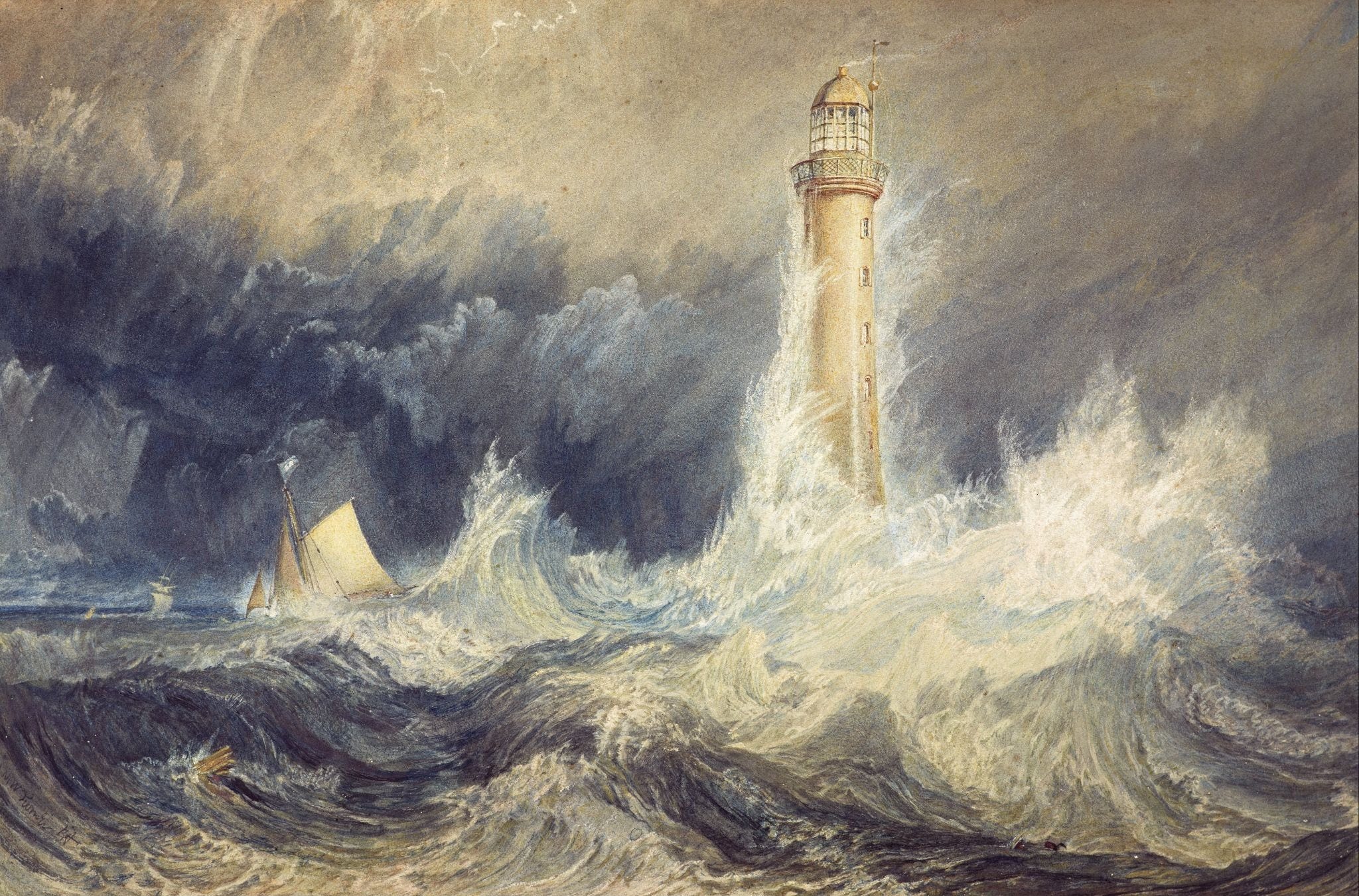
Joseph Mallord William Turner (1775–1851), Bell Rock Lighthouse (1819)
Invictus
It matters not how strait the gate,
How charged with punishments the scroll,
I am the master of my fate,
I am the captain of my soul.”
- William Ernest Henley
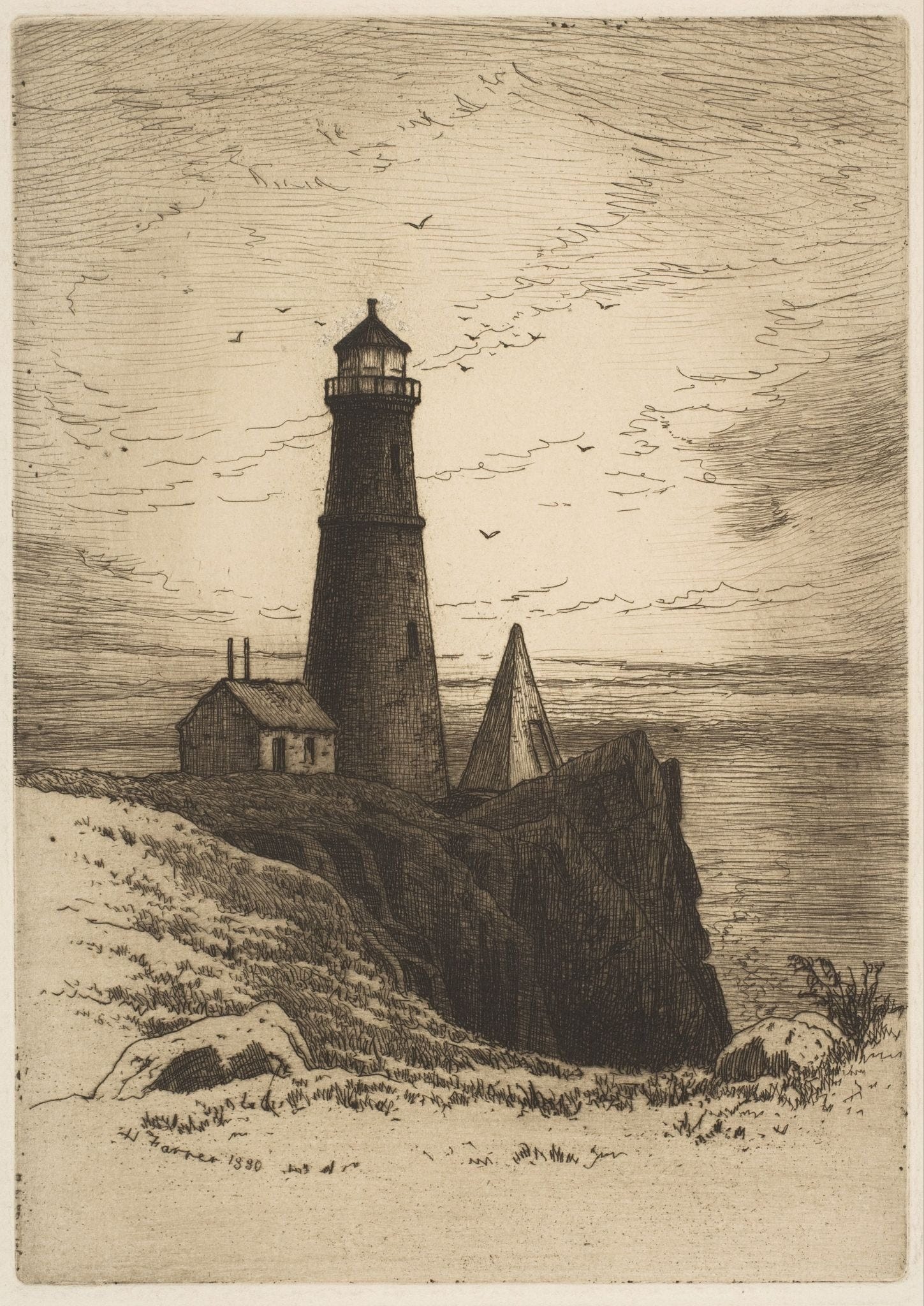
Lighthouse by Henry Farrer, 1880
“ One bird said, ‘Poo-tee-weet?’”
-Slaughterhouse V, Kurt Vonnegut
Introduction
Do you have the strength to be a hero? Do you have what it takes, both physically and mentally, to be a hero in the fallen world? Are you willing to sacrifice? Each and every one of us is given the station to become the hero of our life, and in this timeline, however, most decline to accept the station. They allow the mantle of hero to be taken up by stronger men. For it is only the strong and resilient that make it to the final steps and are enmarbled as heroes.
So it goes. I am the master of my fate, I am the captain of my soul. We stand on the coastline looking out to the ocean, as the waves crash and fold over one another. The clouds collide, thundering in the air. The horizon dividing the ocean and the sky becomes indistinguishable. The ships far from the coast are thrown around, with their pleas unanswered by the storms. As the storm rages on, the lighthouse appears strong, still, unmoved by the clouds above, the waves below. The Lighthouse is unshaken and composed in the storm, as its light pierces the darkness, aiming towards the ships. The rocks, the waves, and the coast, which were untraversable, become illuminated and traversable. To the simple person along the coast, it is simply a picturesque scene. The above imagery is seen in Joseph Mallord William Turner’s painting, The Bell Rock Lighthouse, from 1819, which outlines that scene in a captivating and wondrous way. However, this is not merely a beautiful painting; it is a window into what it takes to live life fully. It highlights the difficulty, the struggle, and the toil it is to find the right path in life, and how we can navigate the stormy waters despite the darkness.
This paper will argue that our lives are aimed at the divine–something that exists beyond the temporal world–which, in order to achieve, we must develop our souls and become heroes, in order to make it to the proverbial port of salvation. However, navigating to the port is a difficult, dark, sometimes seemingly impossible, hopeless, and pointless journey, if not for the Lighthouse and the Lightkeeper. It is the Lighthouse that is the bastion of our guidance, and it is the Lightkeeper that does not undertake the journey of life for us, but rather illuminates the path for us, aiding in our journey.
In order to understand the journey to becoming great, first, the State of the Storm will be understood through Augustine’s City of God, Emmanuel Mounier’s Personalism, and John Green’s Looking for Alaska. Second, the desire to quest is explained through Plato’s Symposium and Pope Benedict XVI’s Deus Caritas Est. Third, the Lightkeeper and Heroes are shown through Thomas Carlyle’s On Heroes, Hero-Worship, and the Heroic in History. Finally, the work of the Hero is explained through reconciling everything aforementioned, plus Alasdair MacIntyre’s Dependent Rational Animals.
Part I: What is the Nature of the Storm?
Returning to Turner’s painting, it is easy to be an observer of the ship and storm; however, we are the ship amongst the storm. All around us, everything seems doomed. Modernity seems to provide nothing but chaos and crisis. Whether from nuclear annihilation, economic collapse, or some other global crisis, the biggest things around us seem to be in constant jeopardy. It appears to be as such for our lives as well. It seems that everyone is apathetic towards the future and is plagued by anxiety, depression, and hopelessness. It seems like it is all ‘over.’ Many reasons have led to this crisis, but there is a crisis of meaning and purpose in today’s society. It seems like the storm is causing society to break apart at the seams. Leading to a dark fog that has descended upon everyone, giving a feeling of apathy about the future. The dividing horizon of the sky and sea becomes unclear. It makes asking the following questions seem pointless: What is the purpose of life? What is it that I ought to do? What does it mean to die well? What is a life well lived? The material quality of life has never been greater, and we have more idle time than any generation prior, yet we have no answers to the most important questions.
These questions are the first step of the journey. It is here that we are asking the Oracle for answers. The oracle responds to you only in riddles, in which the answer is always true, but never the answer you thought you wanted. The answer, however, leads you on a quest to achieve the truth of the question. It is hard to say how, what, or why exactly, but it is clear that you must undertake a quest. The giving of the gift is desire for it is the cause of the journey. The question shows a lack within yourself, and the quest is the journey to fill that lack with something beyond the individual. Through desire, the journey begins when we begin to search for answers. However, those answers are not revealed initially. It is only after the journey is undertaken that the answers become clear. In this way, the journey is neither exclusively about the journey itself nor the destination; it is about finding flourishment in our souls through the development of our character.
Before we can understand the journey and the quest itself, we must identify the current state of affairs compared to the ideals. We all have some grasp of what is happening in the world. There is a constant feeling of hopelessness, lostness, and meaninglessness. It seems that the world is aimed towards expanding glory, wealth, and power. It seems that the focus is on greed and the individual exclusively in a way where everyone else suffers. Augustine, in the City of God, looks back at what led to the fall of Rome. In this perspective, he addresses what was thought to be the end of the world as it was known. He posits that even with the adoption of Christianity, it failed to adopt the necessary principles to create a truly Godlike empire that would withstand the test of time. Augustine suggests that self-love and pride perverted the goodness of the empire, leading to selfishness and the dissolution of society. The Romans, motivated by glory, had a shift in the type of glory they sought after. Augustine identifies a shift from the old glory or true glory, which focused on a path of virtue to promote certain behaviors and suppress vice, such as love of dominating, greed, and wealth, to a new glory focused on greed and the advancement of the individual. This was rooted in the idea that right behavior would lead to a good reputation. This was never a stable solution for individual growth or communal growth. It was no longer about virtue; it was about self-love. In turn, the Romans abandoned God through this newfound love of greed. “But at least the greed of glory should be overcome by the love of justice; and so, if things which are themselves good and right ‘lose lustre’ because of general disfavour, then the love of human praise itself should be ashamed, and yield place to the love of truth “ (Bk V, Ch 14, p203). Augustine is identifying that putting greed before the love of justice and the love of truth, society erodes and falls apart. The bonds that originally brought us together are dissolved once we focus on the self, because of the perennial temptation to care too much about how others view us. Greed and self-love are lower goods that are not shareable like the higher goods of virtue and communion.
Augustine creates the dichotomy, contrasting the City of God and the City of Man. The City of Man is our earthly world, focused on self-love and breeding vice, therefore lacking true communion. Whereas the City of God is complete and pure communion, focused on the love of God and His love through us. It is a true res publica or commonwealth where we all take part in all. The City of God is the highest good and therefore the most shareable for everyone to participate in. The aim of the City of God is for the love of God to aid in the enjoyment of the world, God, and one another in God. This is rooted in the idea that God gifted us the material world not to use God to enjoy the world, but rather that God gave us the world to enjoy Him through the world. In this way, we are called to be gardeners of the world, opposed to miners. The call is to nurture the temporal world, to help foster growth. This important distinction was not understood by the Romans, leading to their full participation in the earthly city and therefore erosion of their societal sense of purpose.
Augustine further posits that politics should work as the backbone of communities to make them closer to the City of God, and less of the City of Man. Doing this at first blush appears to lessen one’s share in goodness, but Augustine posits the opposite. He calls us to all participate in goodness for it is a higher good and therefore more shareable than lesser goods such as glory, wealth, and power. The more people sharing in goodness, the greater the goodness. “A man’s possession of goodness is in no way diminished by the arrival, or the continuance, of a sharer in it; indeed, goodness is a possession enjoyed more widely by the united affection of partners in that possession in proportion to the harmony that exists among them” (Bk XV, Ch 6, p601). This requires an abandonment of the earthly city mentality that one should possess something entirely and not share. This is true for lower goods, but for goodness, justice, and God’s love, we can all share in it, without diminishing our share. It calls for us to work together with the crew members to reach the port. It is not about being the one who “saved” the ship or “brought it out” of the storm. Rather, we work together to bring it safely to port. (This will be touched more on with the giving and receiving relationships of both society and of the Captain–Lightkeeper).
Augustine’s thesis, “the earthly city was created by self-love reaching the point of contempt for God, the Heavenly City by the love of God carried as far as contempt of self” (Bk XIV, Ch 28, p593). In this, we find ourselves somewhat at odds with our self-love and self-interest in order to love God fully. It calls for a sacrifice of earthly desires for something deeper and more fulfilling. Something that brings us all together for a higher good. Augustine calls sacrifice a ‘divine matter’ (Bk X, Ch 6, p379), just as Jesus Christ took up the cross and crucifixion for all of humanity. We are called to do similar to take up the cross of restoring our society and aligning it to a higher good, which is the City of God, through the use of community, institutions, and politics to achieve it.
The Romans, like most of us today, focus more on what others think of us. There is a focus on doing good to exclusively achieve a higher reputation or status; it is no longer about the development of character in this way. Augustine calls for us to develop the City of God on Earth in order to honor God directly, through fellow man, and through the world. Through the things that honor God, we develop our souls and find communion with others. This journey is not individualistic or isolated; it is done with others.
Emmanuel Mounier, in his work Personalism, echoes Augustine’s estimation that humanity and society have become individualistic and abandoned the journey of the soul. Mounier’s assessment of individualism isolates and pushes persons apart. He argues that it stems from the mutual isolation and defence of the individual from other individuals. It gives rise to the glory-chasing mentality of the late Roman Empire. Individualism created the mentality of seeing people as profit-making associations over human connection, and that society should orient itself to allow for each individual to expand their control over the world.
Man in the abstract, unattached to any natural community, the sovereign lord of a liberty unlimited and undirected; turning towards others with a primary mistrust, calculation, and self-vindication; institutions restricted to the assurance that these egoisms should not encroach upon one another, or to their betterment as a purely profitmaking association–such is the rule of civilization now breaking up before our eyes, one of the poorest history has known. It is the very antithesis of personalism, and its dearest enemy (Mounier, Personalism, 19).
Our society is poor, not monetary, but poor in spirit and support. We are alone and left unattached. The institutions created do not bring us into them, for they cannot encroach on our lives or other institutions. Similarly, every individual should be met with mistrust, with calculation of how to use them or how they might use us. The stormy ocean has become even more dangerous, with not only the storm but also other ships that could open fire upon you. However, there is more to life than this outlook. It does not have to be seen this way exclusively. The individual can purify themselves to become persons through their transparency and availability to their fellow person. “But the person is only growing in so far as he is continually purifying himself from the individual within him. He cannot do this by force of self-attention, but on the contrary by making himself available and thereby more transparent both to himself and others” (Mounier, Personalism, 19). It seems counterintuitive at times that we should be of use and aid to a fellow ship in the storm; however, it is what helps us get to port. When we see another ship taking on water, it is our duty to help it stay above water. First, it’s the right thing to do, and second, you never know when you will need the favor done back to you. It is through seeing life beyond our own perspective that we open ourselves up to being a person turned towards the other. It is here that we arrive at a pillar of the human condition, “The primary action of the person, therefore, is to sustain, together with others, a society of persons, the structure, the customs, the sentiments and the institutions of which are shaped by their nature as persons; a society whose moral constitution we are so yet only beginning faintly to discern” (Mounier, Personalism, 21). Our society has failed to incorporate the bringing together of persons, in which structures and institutions are created to further support, develop, and nurture individuals into becoming persons. The storm has raged on without the ships working together nor looking for the light of the lighthouse. It is when we come together that the waters become navigable.
Many turn to the institutions, blaming them for the perpetuated struggle of classes and the oppression of man by man. Mounier suggests that we cannot be sure whether the institutions were the cause or the effect. Perhaps fighting them is a noble pursuit, but the option to promote flourishing of the self and others comes from supplanting them with other structures that we can eliminate individualism (Mouiner, 25). It is when we turn to one another and come together that we undermine the oppressive structures that have and will always exist. In this way, the love of life, love of self, and love of others become certainty in our call and purpose of life. “Love is the surest certainty that man knows; the one irrefutable, existential cogitio: I love, therefore I am; therefore being is, and life has value (is worth the pain of living). Love does not reassure me simply as a state of being in which I find myself, for it gives me to someone else” (Mounier, 23). We can find ourselves willing to bear the struggle of the storm, and of helping our fellow ship through the profoundness of the good. We find ourselves closer to the divine and the port of salvation, while subverting the failing society we find ourselves in. We affirm not only ourselves but the other in our collective suffering and pursuit to make it out of the storm. The storm itself calms as clarity and purity are achieved. “The earthly city was created by self-love reaching the point of contempt for God, the Heavenly City by the love of God carried as far as contempt of self” (Bk XIV, Ch 28, p593). It becomes impossible to live as the Romans did; it becomes impossible to imagine any way without the person at the heart of the story.
However, the problem of the storm does persist. There is no denying the storm, nor should we forget about it. The storm is a labyrinth in this way. John Green, in Looking for Alaska, beautifully depicts the struggle of the storm and man’s purpose within it. “You spend your whole life stuck in the labyrinth, thinking about how you’ll escape it one day, and how awesome it will be, and imagining that future keeps you going, but you never do it. You just use the future to escape the present” (Green, 54). We spend more time fantasising over it and dreaming of a world beyond us, so we never go out and achieve it. The labyrinth controls us, and it becomes a maze, with constant wrong turns leading us into rougher waters and the rocks. It is only under examination that it becomes clear that the labyrinth cannot be denied; it must be embraced. “After all this time, it still seems to me like straight and fast is the only way out–but I choose the labyrinth. The labyrinth blows, but I choose it” (Green, 216). As the main character learns at the end of the novel, the labyrinth ‘blows,’ it sucks, it is a mess, but we must embrace it in order to escape it. The labyrinth itself only has one path, and you must follow it. There are really no wrong choices, only apparent wrongs. Similar to the labyrinth, the lighthouse provides only one path to undertake. You still have to progress through the labyrinth and the storm; however, by accepting it for what it is, it becomes traversable.
As the storm rages, it still seems easier to hide, pretend the storm and the labyrinth do not exist, and pretend that we are at home. “Before I got here, I thought for a long time that the way out of the labyrinth was to pretend that it did not exist, to build a small, self-sufficient world in a back corner of the endless maze, and to pretend that I was not lost but home. But that only led to a lonely life accompanied only by the last words of the already-dead, so I came here looking for a Great Perhaps” (Green, 219). There is no denying the labyrinth or the storm, regardless of what lies, delusions, or images are created in an attempt to hide it. It is never enough, and we are never at home; there is a desperate, wounded lack within us, causing us to yearn for more. We yearn for the answers, the truth, and the Great Perhaps of what life means. For the Great Perhaps is not a simple, clear answer, but rather the quest of seeking the answer.
Part II: What are our souls called to do?
However, why should we leave the storm? Why not drop the anchor and wait out the storm? Why should we think it will get better or that we could even get to the port? The answer to this is that it is a tragedy regardless. The storm will never end, for there will always be conflict, crisis, and crying throughout life. It is better to move through the storm than wade in it, hoping it to get better, for willing it to get better outweighs idleness. It gets better as we get closer to the thing for which we desire. It is a tragedy whether or not you stay in the storm. Our lives are ephemeral; they will end upon death. This leaves you two choices: stay in the storm that is pleased by temporary, thin, apparent goods or bring catharsis to the end of your tragedy.
Life–at least temporal life–is a play, one that begins at your birth and ends in tragedy upon your death. However, there is catharsis at the end. We are all doomed to die; our ending is foretold in the sense that it will happen. There is no changing it, alternating it, or even preventing it. No program, no course, no product will stop the great equalizer of death. So what are we to do about this tragic reality?
If life is a tragedy, should we give in? We can continue to give in and exist within the storm, allowing the storm to control and dictate our lives. The ship can anchor, can stay stagnant, it can be motionless. Yielding itself to the storm, to evil, to death itself.
However, it is important to remember that everything that is, that is alive, that changes, changes towards some end. All things have a proper end, upon which all their existence is aimed. For the acorn is aimed at growing into an oak tree. For the end of a knife is a sharp edge that cuts well. A good or excellent eye is one that sees well, and for an ear, one that hears well. This is excellence, and we are called to do it in all functions of life. The human life aim, or telos, is flourishment. It is for the preparation for death, for oneness of the universe.
All life points to the divine. The divine being something that exists beyond the temporal world, that does not abide by our rules, and that is not limited by time. All of the temporal world participates in the divinity, in partiality, but not completely. Our souls are filled with desire, yearning for something beyond us. For something we do not currently have. This desire is never fulfilled within this temporal world and can only be truly actualized at death, when we come to be one with the universe, goodness, true unity, and therefore God.
So is life a tragedy? Is it all lost? I mean, you, me, and Thomas (the good doubter he is) are all dying. There is no stopping that. However, we can have a life that is a tragedy or a Heroic Tragedy aimed at the Divine, where we are called to be Heroic and great. Life that is just a tragedy is one where its telos is focused on the material, on the temporal, on the goods that are acquireable. It is a life focused on power, control, and expanding wealth. Ultimately, it is a life of ephemerality. It is a life that accepts that the end is merely death, that there is nothing more, and that the only thing that matters is the material world. It is a rather hedonistic pursuit and outlook on life.
The conclusion is not the annihilation of yourself or your identity. Rather, it is to reform, to change, to adapt. It is never too late, and never too early to undertake the quest of life. The light of the lighthouse is always shining for when you are ready. When the time is now, you can begin the quest and begin writing your own Heroic Tragedy, one aimed at something beyond the temporal world. A life that is aimed at goodness, at beauty, and at truth. It seeks to become one with all that is and become balanced with the harmony of the universe. In this way, fulfillment is guaranteed, and salvation is bestowed. The life of the Hero becomes one of the search for self-transcendence, to go beyond instincts and beyond the material.
So, where does the transformation from tragedy to Heroic Tragedy begin? It begins with ecstasy. The feeling of ecstasy, and partially for its namesake, is a feeling of being brought beyond oneself. It comes from the Greek ek-stasis, which literally means “to stand outside oneself.” It is important to remember that to be human is to desire. As human persons, we lack generally and particularly. However, for all desires and lacks, there is something to quench and satisfy the desire, to properly satiate the soul. For the desire of thirst, there is water. For the desire of hunger, there is food. For the desire for tiredness, there is sleep. For the desire of wholeness and completeness, there is love. For the desire of fulfillment, there is God. The latter two are purely discovered through the quest. In Plato’s Phaedrus, Socrates explains this type of ecstatic feeling as the unreasoning desire that overpowers a person, driving them to take pleasure in beauty, becoming all-conquering. He calls this eros. Socrates goes on to explain how eros brings about a state of mania, where the person goes ‘mad’ in the pursuit of beauty.
The transformation and the beginning of the journey begin before even going anywhere. It is during an epiphany or sudden revelation that we realize that there is something greater to life. The realization of the Divine, of pure goodness, beauty, and truth occur. Perhaps when looking at something beautiful, in conversation with someone wise, or often upon contemplation, wandering through the mind. It is at this epiphany that we realize there is an advent or something to come. What is to come is the deeper thing upon which we engaged, that pulled us out beyond ourselves. Upon being moved, we turn to the Oracle. Asking the question, the Oracle appears to be useless, for the riddled answers pose no solution. It becomes clear that the answer is some type of journey, an adventure into the unknown. To undertake the Heroic Tragedy is to accept the adventure completely and entirely despite fear, concerns, and doubts. While on the adventure across the desert to the pyramids, we transformed, and our lives pointed to something beyond the temporal world. Your life turns to something that is constantly ecstatic, erotic, and filled with eros. The desire finds its rest in something beyond itself, and the only thing that can satisfy it is the divine. It is the only thing that does not desire from a place of lack.
By undertaking the erotic life, we feel catharsis in two major ways. Catharsis, being a purification or release of emotions, for Aristotle, is pity and fear, through experiencing tragedy, bringing balance and clarity to one’s emotional state. The aim is to develop oneself and to fundamentally alter one’s character. The first major moment of catharsis is upon the epiphany, when forced to look back at one’s life to see that it has been living aimed at apparent goods. The pity for the way you have lived, and the fear you have about living a new way, are intense, but they are released at the point upon which the adventure is undertaken. Throughout the adventure, lesser catharsis takes place, for purification and release of emotions is a constant process. The second major point of catharsis is while dying. It is while dying that we are overcome with pity for how we lived, and fear of what death might bring. But it is when death overwhelms us that we release all that we feel and are brought to be one with the universe and to God. This second catharsis can only occur if we accept the adventure, and see to powers beyond the temporal world.
The journey and the adventure can be denied. In Plato’s Symposium, Socrates attempts to bring Alcibiades to undertake the journey of truth and beauty, but Alcibiades ultimately is unwilling to go on the adventure and abandon the temporal life he had. Alcibiades was a successful young Athenian general and politician. Socrates, acting as the Lightkeeper, had inspired Alcibiades with his beauty and words. “I [Alcibiades] have heard Pericles and many other great orators, and I have admired their speeches. But nothing like this ever happened to me: they never upset me so deeply that my very own soul started protesting that my life–my life!--was no better than the most miserable slave’s” (215E5-9, p67). The other orators are merely lightbulbs, candles, or even the sun, which were not special like the Lighthouse. Socrates is the Lightkeeper, where the light comes directly from the divine, and not by artificial means. Alcibiades feels as if their life is no more than a slave’s, because it has been lived wrongly. “He always traps me, you see, and he makes me admit that my political career is a waste of time, while all that matters is just what I most neglect: my personal shortcomings, which cry out for the closest attentions. So I refuse to listen to him; I stop my ears and tear myself away from him, for like the Sierens, he could make me stay by his side till I die” (216A4-216B, p67). Alcibiades has received the first half of the epiphany–the advent–accepting that there is more to life, and that there is a quest to begin on; however, he does not accept the adventure itself. He is unwilling to stop neglecting his personal shortcomings, instead making the false dichotomy that he must abandon his political career. The story of the Hero is not to abandon the positions we are in, but rather to add the true nature of the human person, which is the quest for the Heroic Tragedy. Alcibiades’s heroic tragedy perhaps is to be a great statesman; however, he cannot achieve that without being to quest for the good life, follow virtue, and embrace beauty in everything. Instead, he denies the light and the lightkeeper, blinded by love of glory, accepting the nature of the storm, for which he cannot flourish. Alicibades affirms this by stating that Socrates is the only man in the world who has made him feel shame, insofar as his life is lived wrongly. Alicibades here has the moment of ecstasy, but still denies it. This ordains his future to fight the storm forever, without the help, assistance, and guidance of the lightkeeper or Socrates. “My whole life has become one constant effort to escape from him and keep away, but when I see him, I feel deeply ashamed, because I’m doing nothing about my way of life, though I have already agreed with him that I should. Sometimes, believe me, I think I would be happier if he were dead” (216B7-216C2, p67). Instead of going on the journey, Alicibades will fight the storm for the rest of his life; he wishes Socrates to be dead; however, the light will persist and continue. The feelings are not fleeting, and denying them only propagates more suffering in a life lived poorly. Socrates then expands, saying that Alcibiades–who thinks Socrates is just using him for his beauty–explains that “Nothing is more important to me than becoming the best man I can be, and no one can help me more than you to reach that aim” (218B2-3, p70), explaining that love and beauty goes both ways. The lightkeeper is fulfilled through the ships accepting its guidance and being brought together. Most people fall victim to becoming Alcibiades, through recognizing and desiring the good, but ultimately choosing to continue pursuing the lower goods of glory, pride, and power. In this way, eros has become tyrannical, pulling us away from the harbor. This is why the light meets us first before eros in order to guide. Our eros is part of our human nature, as wounded and desiring creatures or critters. However, eros needs to be matured and nurtured as ot prevent it from becoming tyrannical.
There is a certain relationship between love and the Divine: love promises infinity, eternity–a reality far greater and totally other than our everyday existence. Yet we have also seen that the way to attain this goal is not simply by submitting to instinct. Purification and growth in maturity are called for; and these also pass through the path of renunciation. Far from rejecting or “poisoning” eros, they heal it and restore its true grandeur” (Deus Caritas Est, Ch. 5)
The relationship between man and the Divine is also innate to being a human person. Our eros as our souls are aimed at goodness, at happiness, and the true, for which is fostered through the habituation of virtue, and through the maturation of understanding. Eros seeks to have complete possession of the good, which can only be encountered through the self-depossession of the thing. Agape allows for genuine self-depossession by ordering the self towards expansion and true communion. Eros seeks to freeze the Cherry Blossoms when they bloom, while agape helps the self to mature to understand the true beauty of the Cherry Blossom is the cycle through the loss of the blossoms, the cold winter, and the re-blooming in the Spring. The Beauty is in the complete cycle, which can only be seen from the perspective of self-depossession.
The light of the Lighthouse is agape, which meets our eros and accompanies it throughout the journey. It is embodied by the Lightkeepers themselves when we come into contact with them. In this way, agape and eros are both forms of love that can be applied to all aspects of life. This is precisely what Socrates was calling Alcibiades to do. “Love is indeed “ecstasy”, not in the sense of a moment of intoxication, but rather as a journey, an ongoing exodus out of the closed inward-looking self towards its liberation through self-giving, and thus towards authentic self-discovery and indeed the discovery of God” (Deus Caritas Est, Ch.6). The journey of eros is not for lower goods, it is for the higher goods, for the creation of the City of God on Earth. In this way, agape becomes the guiding force within our souls as we seek to form the world to God’s will.
Part III: Who are the Lightkeepers, and what are they called to do?
The world is fallen, the world is dark and stormy. We desire to find the port, to go on the quest to discover the answers to the universe, but where do we begin? How do we find our way and who to look to? The lighthouse that pierces the darkness illuminates the darkness. The lighthouse manned by the Lightkeeper helps us find our way. However, in the fallen world, many people are consumed by vice, by sin, and are selfish. They are misguided, pulling the ship captain away from the journey, and they pull the captain away from the things that matter most. Similar to Alicibaides, the hero continues to neglect the personal matters that are most important. The evil keeps us in the midst of the storm, watching us flounder as the waves crash over the deck. It is the Lightkeeper that is virtuous, good, and beautiful, that guides with honor and truth, bringing the ship to harbor. The Lighthouse and its Keepers meet you where you are. They met you in the depths of the storm and guided you out.
The Lightkeeper in its perfect form is Jesus Christ. He who has come down from Heaven in order to redeem and save the world from its own fallen nature. Jesus becomes great and virtuous, prepares himself to guide people throughout his travels and stories throughout the Gospel, and then prepares Himself for the ultimate sacrifice on the Cross. “Jesus portrays His own path, which leads through the Cross to the Resurrection: the path of the grain of wheat that falls to the ground and dies, and in this way bears much fruit. Starting from the depths of His own sacrifice and of the love that reaches fulfilment therein, He also portrays in these words the essence of love and indeed of human life itself” (Deus Caritas Est Ch. 6). We are all called to give, to sacrifice, and to pour our excess to others. Not all are called to give their lives for the greater good, but we are all called to be bastons of God’s will through the giving of gift or agape. In this outpouring of love, we guide and love the world and the people in it. The Lightkeeper is called to redeem the world as Jesus redeemed the world, through the fostering of community, the development of the individual, and the nurturing of the Common Good.
The Lightkeeper becomes the hero for many people’s lives, for they guide the hero through the storm and bestow wisdom to those who follow. Thomas Carlyle, in his six-lecture series On Heroes, Hero-worship, and the Heroic in History, provides a framework for six archetypes of heroes and how they have embedded them in history. By taking key concepts of each type of Hero and expanding them, the archetype of the Lightkeeper is formed. For it is the Lightkeeper that we are striving to be here on Earth.
The Lightkeeper, in many ways, is the redeemer of the current world in bringing those to the divine. Without the Lightkeeper, men would not have been moved to undertake the impossible and become great. “In all epochs of the world’s history, we shall find the Great Man to have been the indispensable saviour of his epoch;--the lightning, without which the fuel never would have burnt. The History of the World, I said already was the Biography of Great Men” (Carlyle, 98). The Lightkeeper is the lightning that strikes the soul that moves the ship through the storm. Without it, the ship would remain in the storm forever, or similarly, the individual would remain stagnant, uninspired to undertake the impossible. History is the biography of the Great Men that have done the impossible, that we are called to participate in as a response to being pulled by the Lighthouse.
When identifying the Hero as Lightkeeper, there is something profitable about their company and comfort that is taken from being in their presence. Knowledge is not gained from laying next to them, as Alicibiades asks Socrates, but through grappling and engaging with the Lightkeeper directly. The Great Men are those who are like the lighthouse itself a light-fountain.
He is the living light-fountain, which it is good and pleasant to be near. The light which enlightens, which has enlighted the darkness of the world: and this not as a kindled lamp only, but rather as a natural luminary shining by the gift of Heaven; a flowing light-fountain, as I say, of native original insight of manhood and heroic nobless;--in whose radiance all souls feel that it is well with them (Carlyle, 89-90).
The Hero is the Lighthouse itself, for which luminates all that is around it. There is something divine and perfect in the Hero that others can embrace and follow. It is not something that the Hero created, rather something that flows forth and from the Hero. It is true inspiration, for which the divine breathes life into. The true nature of the Lightkeeper is their alignment with the divine, and with the port itself. They can see beauty in a truer form, like Socrates, and seek to bring others to harbor safety. This divine intention and action radiate from the hero like the Lighthouse piercing the storm.
The core of the Hero’s character is what Carlyle identifies as sincerity. “I should say sincerity, a deep, great, genuine sincerity, is the first characteristic of all men in any way heroic. Not the sincerity that calls itself sincere; ah no, that is a very poor matter indeed [...] The Great Man’s sincerity is of the kind he cannot speak of, is not conscious of: nay, I suppose, he is conscious rather of insincerity” (Carlyle, 121). This sincerity is core to the Hero, in a way where they cannot even recognize their own goodness, and are more focused on their own insincerity. Their goodness is so integral to them that it exists prior to any greatness. “A Great Man, we said, was always sincere, as the first condition of him. But a man need not to be great in order to be sincere” (Carlyle, 179). Sincerity guides every decision of the Lightkeeper, and they call others to act the same. It calls for acting virtuously and doing right by every person in every decision.
The Hero’s greatness comes from their ability to see and comprehend the open secrets of the divine. “The open secret – open to all, seen by almost none! That divine mystery, which lies everywhere in all Beings, ‘the Divine Idea of the World, that which lies at the bottom of Appearance” (Carlyle, 146). The Heroes can see the good, the true, and the beautiful. The ability to see what lies at the bottom of Appearance is not hidden; it is something that one needs to open their eyes to see. The Lightkeeper sees the open secrets and understands the salvation of the port, and seeks to bring others to it. Once the lightkeeper sees the open secrets, it becomes the truth that they live by. It is this that Carlyle considers to be religion. “A true man believes with his whole judgment, with all the illumination and discernment that is in him, and has always so believed. A false man, only struggling to ‘believes that he believes,’ will naturally manage it in some other way” (Carlyle, 179). Heroes truly believe in what they know to be true. They understand the way they see the world and how they should live.
The Heroes are ultimately motivated by the Great Fact of Existence, which is the awful presence of reality. The Heroes know that life is finite, and that reaching the end of the journey and preparing themselves for death is the most important aspect of their life. “Fearful and wonderful, real as Life, real as Death, is this Universe to him” (Carlyle, 121). The Heroes understand that the Universe is real and theirs for the taking. The universe can be molded, changed, and used in a way that serves a hired purpose. It can be used wrongly to destroy ships and keep people in the eternal storm, or it can be used as a light that illuminates and guides others.
The Lightkeeper is the truest form of what it means to be a Hero and Great Man on Earth. Their embodiment of the virtuous, and of truth, brings a higher form of society and community to the City of Man. They understand that their possession of the good is only increased as it is shared with more people, and by guiding more people to the port. The Lightkeeper is not praised, paid, or promoted, they are honored and rewarded by the divine for their work in guiding those to higher goods. This is precisely what motivates the Lightkeeper, for they seek no reward other than knowing what they did was right. There is no higher reward than goodness to them.
Part IV: How the Heroes Change the World for the Better, Even If Glim
Life is an adventure and must be seen as such. We must embrace the eros we feel to chase something beyond us by following the light from the Lighthouses. This world and universe are limitless, endless, and ever-changing. The Great heroes of the Greek and Roman Myths, the stories of Heroes in novels and movies, all show us something about what it means to be human. There is something profound about the stories of Bruce Wayne in Batman, Santiago in The Alchemist, or David Copperfield in David Copperfield. We are all called to undertake the journey to the harbor and to salvation. However, before we get there, there are two main goals before we get to the catharsis of the Heroic Tragedy. First, it is improving and creating a better world. Second, is becoming the Lightkeeper.
Addressing the improvement of the world. It is important to note that Carlyle believes that man is not just a learner but also a doer. “Every man, as I have stated somewhere, is not only a learner but a doer: he learns with the mind given him what has been, but with the same mind he discovers farther, he invests and desires somewhat of his own. Absolutely without originality there is no man” (Carlyle, 174). The human person does not want to be idle in a classroom, but to go out into the world and adventure. We can look to the lighthouse and its light, but we never truly embrace the light until it is pursued. When we chase the light, we begin to understand it more fully. Once we do, we are fully moved and overcome with mania for it. “Intellect is not speaking and logicizing; it is seeing and ascertaining for virtue, manhood, hero-hood are not fairspoken immaculate regularity; it is Courage and the Faculty to do” (Carlyle, 246).
This calling is not limited to any one position. Alicibades falsely assumed he could not pursue beauty and greatness in politics. He needed to love justice more than simply praise. Carlyle calls for greatness in all occupations and positions of life, regardless of industry or time. If anything, we should devote ourselves to the divinity and greatness of every position that human persons are found. “I have no notion of a truly great man that could not be all sorts of men. The Poet who could merely sit on a chair, and compose stanzas, would never make a stanza worth much. He could not sing the Heroic warrior, unless he-himself were at least a Heroic warrior too. I fancy there is in him the Politican, the Thinker, Legislator, Philosopher,–in one or the other degree, he could have been, he is all these” (Carlyle, 145). Greatness is not limited to the philosopher or the man in the library. No, the activity of life requires multifaceted approaches and an all-around understanding. The Great Men and Lightkeeper are great because they understand how to navigate the ship, they understand the weather and the storm, they know where the port is, and they know how to use the light to bring the ship to harbor safely. It all comes together perfectly, for if any part were missing, it would not have worked.
Looking to Alasdair McIntyre in Dependent Rational Animals, which explains the importance of giving and receiving relationships that build a community of giving and receiving. The very nature of the ship and the lightkeeper is giving and receiving. The Lightkeeper gives guidance, wisdom, and illumination to the ship while the ship is in a state of need. The ship captain ultimately becomes the Lightkeeper, who then becomes the giver.
When a network of such familial, neighborhood, and craft relationships is in a flourishing state, when, that is, there is a flourishing local community, it will always be because those activities of the members of that community that aim at their common good are informed by their practical rationality [...] For it is insofar as it is need that provides reasons for action for the members of some particular community that that community flourishes (Macyintre, 108-109).
The community becomes navigable and ordered when giving and receiving are upheld. It is only when one believes they do not need or that they do not need that the community breaks down and flourishing is hindered. It is only once we identify our individual good of getting the ship to safety as part of the larger ones it becomes clear that it is part of the common good. Through that, cooperation is fostered to achieve the same ends. In this way, we become megalopsychos, and the greatness of the soul. In the same way, we become big fish in a small pond. We find purpose and meaning by being able to help others. This is why the second goal is to become the Lightkeeper–both in a micro and macro sense. Through possessing the advantages of knowledge and position, it becomes easier to aid others and help them find flourishment. “Most institutions-and not just at the familial, communal, or local level–are in effect small ponds in which individual members can be big fish” (Levin 177). Going from a nobody amongst the sea to being a somebody who guides the boats to safety is an important step for the Captain. In this way, people come together in meaningful ways to do, as opposed to simply being together. The institutions built around this principle create, foster, and defend the desire to reach the harbor. Ultimately, we find embeddedness in the community, in the institution, and in the world around us. Through commitment, obligation, and responsibility, we become members of apparatuses that go beyond us and aid us in the journey to the harbor.
Conclusion
Charles Dickens’s end David Copperfield with: “I turn my head, and see it, in its beautiful serenity, besides me. My lamp burns low, and I have written far into the night; but the dear presence, without which I was nothing, bears me company” (Dickens, 882). This, perhaps, is the answer to the opening lines and question of the book. “Whether I shall turn out to be the hero of my own life, or whether that station will be held by anybody else, these pages must show” (Dickens, 13). It is through Copperfield’s adventure through life that he discovers himself and develops meaningful relationships with the people around him. He finds himself finally at home, in a community that he builds with people who live, specifically his wife, Agnes, for whom the novel concludes with Copperfield calling to in presumably in the moments of his death.
Each person must ask themselves whether they will be the hero of their own life or if someone greater will take up the mantle of hero. No one but you can captain the ship of your life to safety, to port, and to salvation. The journey is for you to undertake. In the fallen world, we are wounded and desiring embodied souls, which, when oriented and opened to beauty, the person experiences an epiphany for which a journey is bloomed from. It is during this journey that we become virtuous, fulfilled, and flourishing human persons, where we build relationships and community with those around us. The journey is lifelong, concluding at our death, and it is upon our death that the purpose of our life is fully realized.
It is important to remember that the journey is not one that is done alone, for the journey allows us to make meaningful connections both as the one following the Lighthouse, and perhaps becoming the Lightkeeper guiding others. We are all called to be a beacon of light to others in the darkness, and bring them to the beauty and goodness they cannot realize in the darkness of their current position. When this type of giving and receiving community is created and fostered, while persons develop themselves oriented to greatness to embody the divine, goodness becomes communal and sharable. Divinity is brought to the world, and therefore, orients the temporal world to something beyond it, giving meaning to the tragic nature of the world of becoming.
We are all called to Greatness, not to become big, prideful, or greedy. The calling to greatness–to the lighthouse–is one of honor, of virtue, and of courage. In the dark, stormy world, it appears that there is no hope, that there is nothing left to strive for, and that there is no God. However, it is in the darkest, harshest part of the storms that we are moved to look beyond the ship into the abyss of the storm, and it is then that we see the light of the Lighthouse. At the peak of the abyss–when all seems lost–clarity pierces the chaos, and order begins. It is here that we encounter Christ truly, and by following the lighthouse relentlessly, we strive to create a self built on virtue, greatness, and honor, which bleeds into everything and everyone around us. It is then that the storm calms, the sky begins to clear, and the port comes into view.
Life is the adventure of a lifetime, both as the pinnacle of what it means to be human, and it lasts your entire life. It is up to us to accept the adventure, the journey, the quest, towards something beyond ourselves. Life could treat you well, blessing you with riches, with power, with bigness, to where questing is worthless. Or you could open your eyes to the beauty that exists everywhere, and allow the quest of life to consume you in every way. It is then that we become the Hero of our life, and a Lightkeeper to those around us. For we are all striving for the divine. So it goes, the bird chirps: Poo-tee-weet?
Respectfully,
AS
Pietas et Litterae
For the Glory of God and the Service of our Neighbor
Biblography
Augustine. City of God. Translated by Henry Bettenson, Penguin Books, 2004.
Benedict XVI. God Is Love: Deus Caritas Est. Ignatius Press, 2006.
Carlyle, Thomas. “On Heroes, Hero-Worship, and the Heroic in History.” Essential Political Writings, Independently Published, 2020,
Dickens, Charles, and Jeremy Tambling. David Copperfield. Rev. ed, Penguin, 2004. Penguin Classics.
Green, John. Looking for Alaska. Penguin Books, 2006.
MacIntyre, Alasdair. Dependent Rational Animals: Why Human Beings Need the Virtues. Open Court, 1999.
Mounier, Emmanuel. Personalism. University of Notre Dame Press, 1989.
Plato. Symposium. Translated by Alexander Nehamas and Paul Woodruff, Hackett Publishing Company, 1989.
Vonnegut, Kurt. Slaughterhouse-Five. Dial Press, 1999.