
Ledger: Society 1
Finding Hope Through de Tocqueville
12 min read
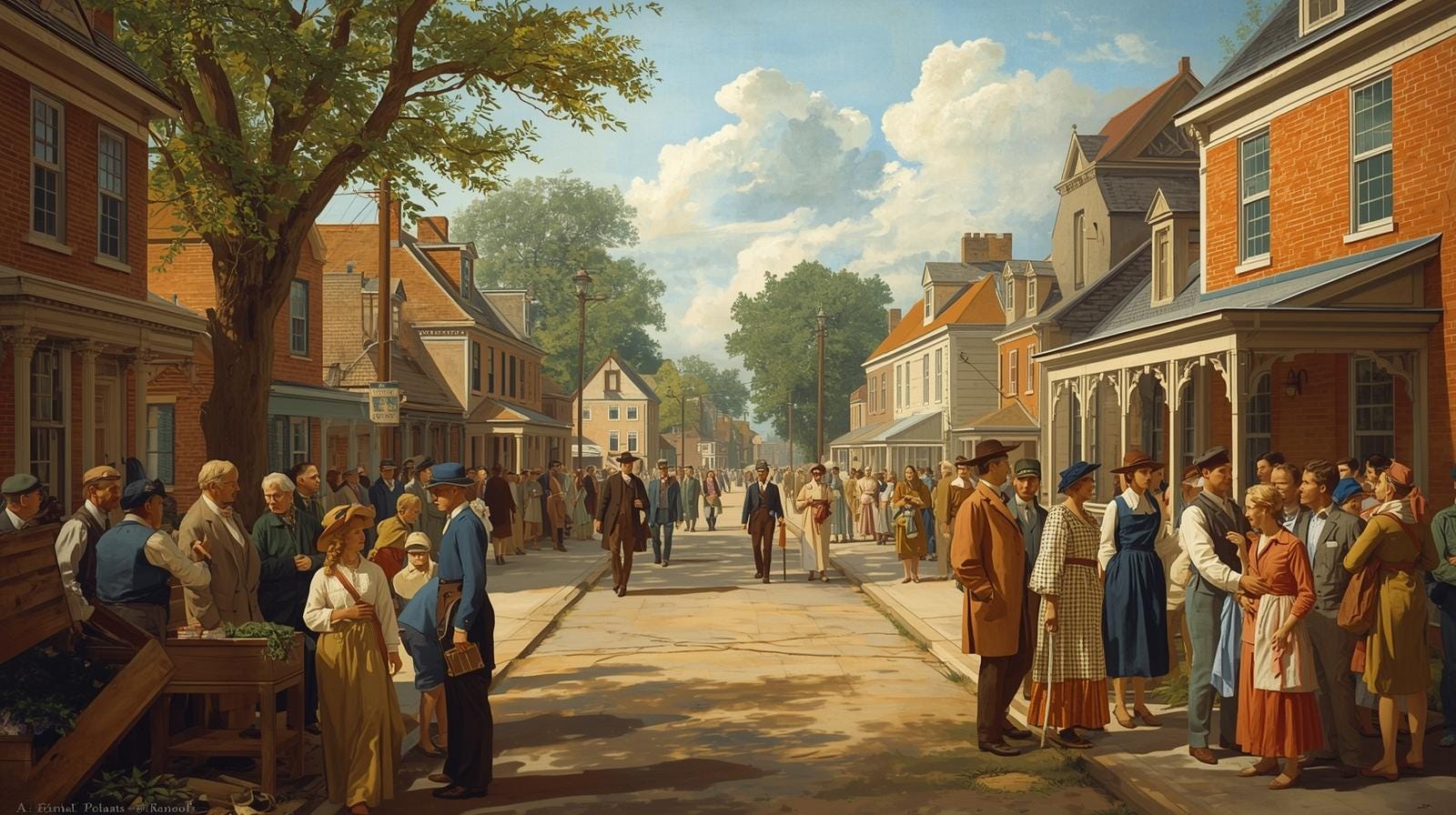
The world is filled with chaos, disorder, and evil. We stand at a pivotal time to make change and to usher in a new order of society–one predicated on hope and aimed at the common good. When discussing the current political climate, many, if not most, people are unhappy, dissatisfied, and looking for change. The natural and most immediate answer is blaming the leaders in government, business executives, and institutional leaders for their top-down decisions that shape our lives. This outlook is justified, logical, and tracks; however, this outlook is wrong and a result of selfishness. Our society has been pulled apart carefully at the seams to focus exclusively on the individual, which we attempt to wash our hands of responsibility. We do not want to accept responsibility for our actions or accept the challenge of making change in our society from the bottom up.
Alexis de Tocqueville, in Democracy in America from 1835, gives a window into a different view of America, one where community was strong, civic engagement was a duty, and American society was strong. It is through Tocqueville that we can develop pathways to bring constructive, tangible, and real change from a bottom-up approach and are reminded of our connection with fellow Americans. By this, we are reminded that America was an experiment held, conducted, and shaped by the average citizen.
The America Tocqueville saw and wrote about is one that can be brought back to life in the 21st century. An important framework for understanding this, and how society shapes government and vice versa, is remembering that the United States of America (America) is a Democratic Republic, where elections decide the fate of the country, and legislation decides behavior. When the community is strong, it acts as a voting bloc and a place of influence where legislators must listen in order to achieve re-election. This leads to wider instability–where legislators are more at the will of the people–but it ensures the retention of power in the people over an Aristocratic or Oligarchic model. “Legislative instability is an evil inherent in democratic government because it is of the nature of democracies to bring new men to power, but this evil is more or less great according to the power and means of actions granted to the legislator” (Tocqueville, 238). The people grant power to the politicians and representatives, which is the direct result of our participation in the township and local forms of government. The people have always and will always retain the most power in the United States, as long as people participate in the principles that created America. It is also through this model that it ensures that new men can join into the political realm, bringing forth the best people to represent a close-knit community.
The United States of America is built on a few key principles to Tocqueville, including the Spirit of Religion, Liberty over License, Administrative Decentralization, and the Township. With the creation of the New England colonies founded by Protestants and other religious groups fleeing Europe, they brought with them moral codes and created localized governments known as Townships. These townships were run by the community–together–and in doing so, there were agreed Morals Laws or Mores. Through strong political and moral bonds, the community was kept together and helped everyone succeed in life, since their life was all pointed toward a higher good–for the New England colonies: salvation. “Therefore, at the same time that the law permits the American people to do everything, religion prevents them from conceiving everything and forbids them to dare everything” (Tocqueville, 280). The Spirit of Religion acts as a guiding force in American life. Things that fell outside of the moral code–even if they were “more efficient” or “more convenient”--were outlawed since they went against a higher order the community agreed was more important. Mores, in turn, acted as a binder for all members of the community.
Tocqueville does not argue that everyone has to believe in the same God o religion in order to have strong moral bonds. He argues that belief in God itself is the focus in order to have similar moral values that are shareable across communities and place. “Society has nothing to fear nor to hope from the other life; and what is most important to it is not so much that all citizens profess the true religion but that they profess a religion. Besides, all the sects in the United States are within the great Christian unity, and the morality of Christianity is everywhere the same” (Tocqueville, 278). Tocqueville is suggesting that belief in any religion or higher order is conducive to the agreement of Mores. To find the Mores important to life, is to see a higher order in the transcendentals–the truth, the good, and the beautiful–which manifests itself differently in different religious orders. However, when actualized, Mores became tangiable and the community can flourish together. Under Christianity, the values most important to America are found and supported. The focus on the family, striving for virtue, and living a life of flourishment find their roots in Christianity and, therefore, America by extension.
Tocqueville argues that this is the root of liberty. “But there is a civil, a moral, a federal liberty, which is the proper end and object of authority; it is a liberty for that only which is just and good; for this liberty you are to stand with the hazards of your very lives” (Tocqueville, 42). Liberty is the freedom to do what is right, just, and good, opposed to License, which is the freedom to act and do as one pleases. License is the pinnacle of Liberalism, where it is right because the individual wills it. Thinkers such as John Locke and Adam Smith argue that the root of the human person and, by extension, the government, is to allow people to do as they please; however, this is not the root of the American Experiment. The root of the American Experiment is Liberty. We do not have the right to do wrong, which is the essence of America’s founding. The Liberty and License was never codified into law because it was unnecessary. The strong moral bonds of the townships provided enough enforcement and promoted restraint, where codified laws would have been unnecessary and redundant. The authority of the government is not to authorize the people to act as they wish, but to act with liberty, to uphold justice as goodness.
This becomes the root of having a vested interest in the community. New Englanders and the rest of America became attached to the township because they retained strength and independence through cooperation with the community. Man is restricted by the township not to commit moral wrongs, but has the ability to govern his life and decide those Mores through his participation in the township. “He is interested in it because he cooperates in directing it; he loves it because he has nothing to complain of in his lots; he places his ambition and his future in it; he mingles in each of the incidents of township life: in this restricted sphere that is within his reach he tries to govern society; he habituates himself to the forms without which freedom proceeds only through revolutions, permeates himself with their spirit, gets a taste for order, understands the harmony of powers, and finally assembles clear and practical ideas on the nature of his duties as well as the extent of his rights” (Tocqueville, 65). Man is brought into the community as an equal, being able to interact with the very institution that restricts his License to see how and why he can and cannot do things. He is taught where his freedom comes from and understands the balance and harmony of the powers that govern. He is no longer–nor never was–an outsider to the political establishment but instead brought up in it as an active player. This remains true for everyone in the township and within the society. Through this, he expands the township and expands the goodness of society for the improvement of the whole.
Man, therefore, accepts society because he is an equal to it and not inferior to it. Society does not speak down to him, but rather because he speaks to it. He is able to govern as the rest of the community and finds himself in union with it. “He obeys society not because he is inferior to those who direct it or less capable than another man of governing himself; he obeys society because union with those like him appears useful to him and because he knows that this union cannot exist without regulating power” (Tocqueville, 61). Man finds himself in union with society and union with the community. It becomes integral to his life and the life of the community. The success of the other, is the success of the individual. The true embodiment of the common god. His decisions for the township are not individualistic by nature, but through the perspective of the collective.
The American Philosophy is beautifully crafted through the mix of all persons together in the township, political, and civic associations. Americans were never interested int he Philosophers and their books, but were able to live what they wrote by default through their own experiences exclusively. “The Americans have no philosophic school of their own, and they worry very little about all those that divide Europe; they hardly know their names” [...] American is therefore the one country in the world where the precepts of Descartes are least studied and best followed” (Tocqueville, 403). The beauty of the American Experiment is through democracy and community; the best ideas rose to the surface and became the rule of law or Mores to follow. This was only possible because of the lack of a class system in America. People were free to move through what would be traditional “class” structures, but since it was never codified in America, they took their philosophies and beliefs with them, sharing them with others. “Men who live in such a society can no longer draw their beliefs from opinions of the class to which they belong, for there, are so to speak, no longer any classes, and those that still exist are composed of elements that move so much that the body can never exert a genuine power of its members” (Tocqueville, 403-404). The Township solidified equality of all members, ensuring that the rich did not overpower the poor and vice versa. It institutionalized a balance that was critical to ensuring Liberty and the flourishment of the community. Modernity threatens this very balance and attempts to usher in a class system, creating further divides between the ruling elite and the working class. It is through the close-knit community and the township that ensures the strength of the people against those who threaten it.
By extension, civic and political associations were created to discuss political beliefs and ideas, bringing people together. It served as another forum alongside the Township to bring unlike people together. “A political association draws a multitude of individuals outside themselves at the same time; however, separated they are naturally by age, mind, fortune, it brings them together and puts them in contact” (Tocqueville, 49). People meet each other and learn to find themselves in the other, deepening the connection of the collective, and aiding in the discovery of what the common good is for the community. Political associations became great schools for citizens to learn the general theory of the associations and politics without charge and without pressure (Tocqueville, 497). Ultimately, they became powerful organizations of people seeking to regulate the state in the same way as their involvement in the Township. It became an extension of the township that operated at a higher level of government and with a broader range of people.
Tocqueville’s analysis of America in the 19th Century is that the decentralized administrative state that materialized in the political associations and townships was successful in bringing all people together as equals in the government and the community. They worked together to develop laws and Mores that they all agreed to live by. Mores and Laws were not means to control or restrict life maliciously, but rather to promote a higher goods (in the case of the New England colonies, achieving Salvation), and promote the good of the community. It enfranchised every American as an equal who was able to participate in the governing of their life and the world around them. The focus was on the community and not on the individual, and when everyone agreed to this, everyone found flourishment.
The 21st Century looks drastically different from the 19th Century. America is filled with a wider range of religions–no longer limited ot Christianity–and has had a population increase both in numbers and areas populated. It seems like the township and community-oriented society is no longer possible, and most people would agree with this. They have given up on the community, the township, and society as a whole. They have attempted to wash their hands of responsibility, yielding the problem to a top-down solution. This is the wrong diagnosis and prognosis of the issue of society.
Reading Tocqueville should spark the opposite reactions. America was built from the bottom up and retained many of the powers, strengths, and protections of the people at the bottom. The top, including the Federal government, expanded drastically after World War II, but only on the back of local communities and voters, allowing politicians to usher in a new political order of rapid federal expansion and diminishing communities. The proper prognosis is radical involvement at the smallest and most local components of the community. The townships still exist, still collect taxes, hold elections and meetings, and are attended by members of the area. The local political party apparatus still exists with Ward elections and meetings. Schools, both public and private, have School Boards, Parent-Teacher Associations, and even groups. Something the 21st Century has that the 19th Century didn’t, is nonprofits. Across America, there is a robust nonprofit network, both with organizations running multi-million dollar budgets, but also hyper-local organizations operating to make real, tangible change. On top of that, the civic associations still remain strong and influential in many cities.
The natural response to this is what power do they have? Everything aforementioned retains an immense amount of power–just used and staffed poorly. They lack vigor, hope, and youth involvement to bring their operations back to life. It is for the individual to decide to go to these meetings, to join these organizations, and accept responsibility as it comes to make changes for the community. It is for you only to bring your friends, to make new friends, and to join these organizations to make the change you wish to see. You cannot expect someone else to do it if you are not willing to do it yourself.
Democracy is by nature unstable. Fair and frequent elections codify this. Americans forget that politicians only win if they get votes, and many politicans especailly at the state level, rely on civic associations, PTAs, nonprofits, and townships for their votes. The reason politicians go to these groups is because the demographics of those organizations are usually “super-voters” or high-propensity voters who always vote, since they are invested in the community. This is precisely what Tocqueville suggests. When you are part of the township, you feel equal and participate fully in it. Many people do not vote and do not get involved, and therefore feel like they are inferior to society. This is a backwards view of society and America.
Fixing this issue comes down to instilling a civic passion in people, especially at a young age. In a time where everything feels powerless, pointless, and hopeless, we have to find hope in order to create change. That hope comes from going to the meetings and attending political associations. It is there that you meet people who are different from you, and you find yourself caring more about the whole of the community than your individual life. It is through bringing people together that they find hope in each other and work together to build a better society.
Tocqueville’s writings in the 19th Century found the hallmarks and key principles that made America the beautiful country it was, but the same principles that remain true today. Once people discover their passion for the community and for the whole, they become hopeful, and through that hope, they become invested in creating a better society with those of the township together.
Work Cited
Tocqueville, Alexis de, et al. Democracy in America. Paperback ed, Univ. of Chicago
Press, 2002.