
Hero Ledger 1
Heroes & Lighthouses 1
7 min read
There are many ways to look at the world, humanity, and the relationship between the two. However, it is most true that the history of the world is but the biography of great men. It is the decisions of those great men who came before us that have defined, created, and shaped our world. This does not exclusively mean the winners, but those who were so great, so impactful that the world would not be the same without them. We see this in every walk of life and how we encapsulate the past. Everything from museums to textbooks to how we discuss current events is formed around the cause and effect of their every decision. However, not all--not most--of these actors are Great Men. Sure, they make decisions and change the course of history, though they do not rise to the level of the Great Men and Hero status. The business leaders and politicians of our world are the Anti-Heroes, those who lead us away from the light and lead us into darkness.
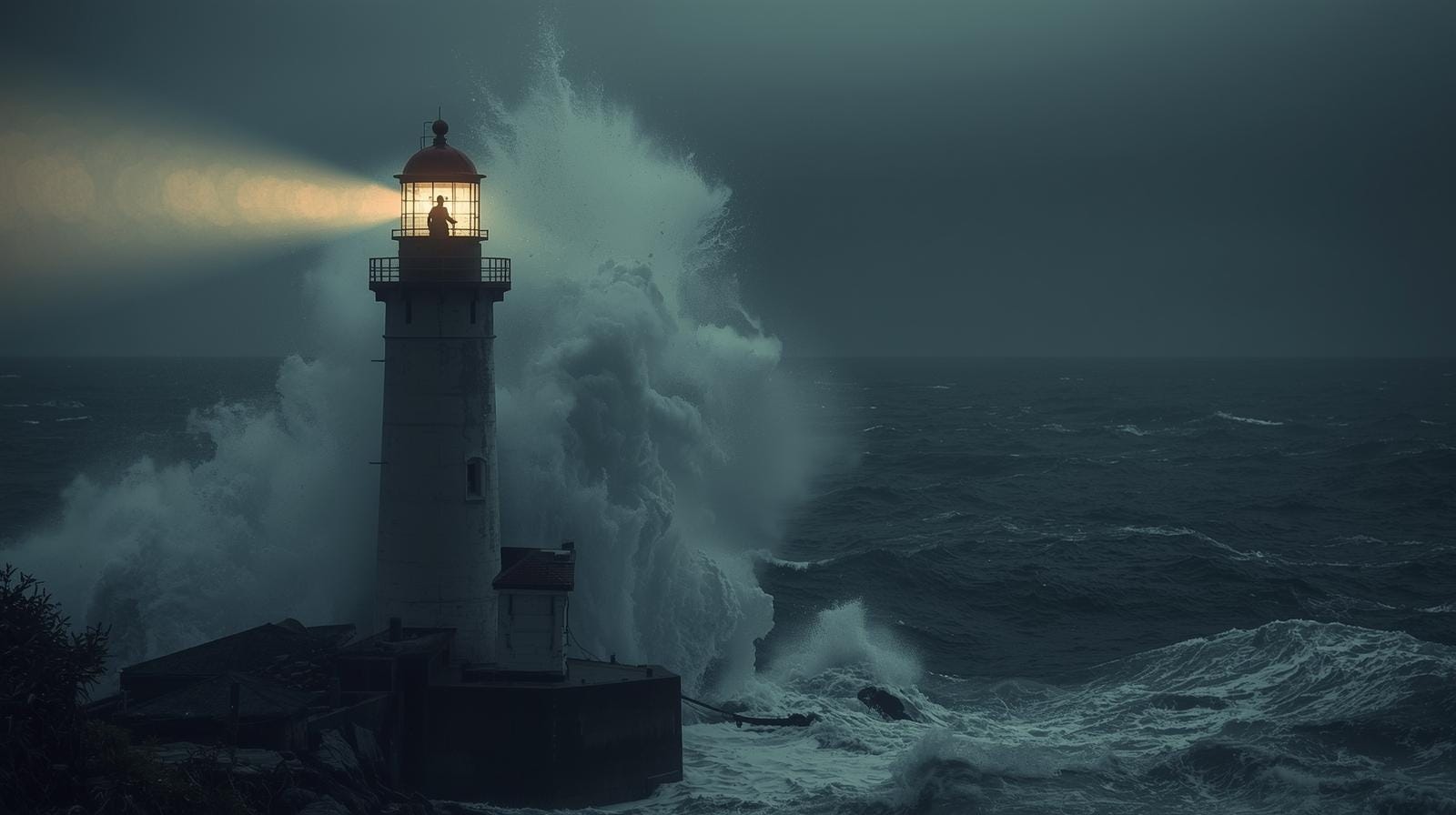
For true Heroes are the Lighthouse Keeper staying guard at the Lighthouse, tending to the lamp that guides the ships through the storm. Heroes are not the light-maker, rather light-bearers. In the same way, they do not create truth, but rather are the arbiters of truth. They are not the source of truth, but rather the truth shines through them. For the truth exists independent of them through God, Nature, and Reality.
The Hero has an inner fire filling them with faith and conviction that burns steadily, not for theatrical purposes, but throughout their life in a constant and authentic way. They cannot live without this flame, and the flame is unwielding to the storm that occurs on the sea. They burn even in the darkness, whereas the parliamentarians, journalists, sophists, and bureaucrats are mirrors reflecting popular opinion and procedural authority, subject to shifting versions of ‘truth’ that go dark when the shift is made. It creates shadows, and in that darkness, evil occurs. The Hero burns regardless of the external environment and the approval of those around him.
We are drawn into the light and the warmth it provides. Humanity is phototropic, being pulled and guided toward illumination without coercion or force. When we are in the storm at sea, we instinctively go toward the lighthouse keeper’s light. He maintains the lighthouse’s light regardless of rough seas or whether someone is in the storm or not. For they cannot comprehend the thought of not maintaining the light and the truth for those who could be in need. Thomas Carlyle calls this the sincerity of the Hero. The Hero is fully and completely sincere, filled with goodness and warmth that we are naturally drawn to. There is always something to learn from the Hero as the arbiter of truth and light. It would be irrational to reject them, leaving recognition to be the only logical conclusion.
This light, however, is not gentle. The light exposes all that there is. As it pierces the storm, it can hurt our eyes in its light, exposing the ugliness of society and the world around us, destroying our illusions. Just as the prisoner leaving the cave, the light is overbearing; it is so encompassing, and it challenges everything we once knew. Initially, we want to retreat back into the cave, for the perceived harshness of the light. But once we bathe in the light, we are drawn to it, just as the Hero always was. This illumination is judgment, not comfort. Leading the Hero to offend, divide, and burn away falsehoods, which a society accustomed to darkness experiences this light as violence. Society shuns and attempts to avoid the light as it appears dangerous. However, avoiding the light that guides us to safety and truth leaves us in the darkness of the truly violent sea.
When we acknowledge that the truth is the light, and the Hero is the lighthouse keeper bearing the light that illuminates us living in full or partial darkness, then following the hero is rational, resisting him is accepting the darkness and denying the truth of the universe.
This type of Hero is filled with sincerity, both internally and externally, solidifying the legitimacy of their goodness. The Hero’s soul is inwardly aligned, having his actions carry moral weight. The focus on the Hero is not procedural legitimacy but rather moral authenticity. Contrasting it against the Anti-Hero, filled with insincerity, which causes social decay, hypocrisy, and hollow institutions.
This sincerity does not make the Hero perfect; however, the Hero believes deeply in what he does, since he is moved by deep moral convictions rooted in an understanding of the truth. Carlyle puts moral earnestness over correctness, legality, and politeness.
This is because the Hero has a greatly intensified perception of reality through the lenses of religion, morality, and social norms. The Hero is deeply introspective from their time in society, and in isolation, keeping to the Lighthouse. While most of society feels and thinks vaguely, the Hero sees the necessity to find clarity and articulate proficiently. The Hero stands at the forefront of their time--regardless of time period--not because of their ambitions purely, but because of their vision of what things could be. They have ultimate access to the light, which moves them to reject the status quo, and strive arduously to what things could be. Their mere existence becomes fixated on the program of restoration of the good in one or many aspects of the world. They cannot rest until the task is undertaken and until it is complete. However, it is never complete, becoming the driving force of their life. It leaves them restless and tirelessly working for the light. It drives them to stand watch all night tending to the Lighthouse, regardless of physical demands.
In the vein of tending to the Lighthouse, the Hero is not a theorist, leaving them to write and isolate themselves purely to bathe in the light. Rather, they are full actors--finding themselves in total actuality--to bring the truth and the light to the world. They tend to the light, which gives them their authority from being. Their lives are defined by heroic actions over institutions and doctrines of what should be done. The Hero goes out and does it. They wake in the middle of the night to bring the light to actualization to guide the ships, over theorizing how and when to do it.
Since the light of the Hero is always burning and always guiding, their authority is earned, not voted or appointed to the position. By undertaking this mission of providing the light, they live by the lapels, shaking life into it, taking their authority. The obedience we give the Heroes is not servitude, tyranny, or fear. No, it is recognition of the order of the world, and the necessity for them to bring us to the light since we are in darkness. We need someone to go up to the lighthouse as the waves, winds, and rains crash against the rocks and the Lighthouse to point the light towards our ship crashing in the waves. We do not have time to vote, to decide, to wait; we need decisive action for our survival and safety. There is no objection to grabbing the reins and lapels to make action. We need it, and demand it from the Heroes.
Unlike the Lighthouse Keeper, the Hero in society does not act alone. They condense and bring together the energy of the age. They utilize social forces that come from each individual, mobilizing them into larger organizations to make systematic change. However, this would not occur without the Hero. Without Heroes society becomes stagnant and remains in decay.
The Hero, grabbing society at the lapel, is not pleasant or tolerant, rather they are filled with moral intensity, holding judgment to the age over flattering it. The Hero sees the truth and strives for it, regardless of what is “of the time” or “now accepted.” The yield to nothing less than the ideal, leading them to be severe, demanding, and extremely divisive towards the truth. The Heroes are not necessarily the democratic and loving leaders we hail of modern standards. They may be violent, authoritarian, or destructive at times in order to bring the truth to fruition. Their legitimacy lies in the historical necessity for restoration and resistance to decay. And even in light of failure, it does not negate heroism. The Heroic Actions must be undertaken even if failure is imminent or certain. Carlyle suggests that Heroes are tragic figures, filled with failure, and interconflict of what the world should be as darkness prevails. These Heroes are tragedies, not Saints.
Ultimately, the Hero is filled with sincerity, embodying truth and making it clearer to guide others to it, exercising authority and instituting change, through decisive catalysts for which history responds and moves.
The Heroes and Lighthouse Keepers cannot go a day, an hour, a moment without the fact of their existence. They cannot live life without acknowledgement and a telos of the truth and the light. The fire burns so deeply, so greatly, so eternally in their souls, they are moved to actualization to make societal change through decisive action--through their means are not always approved by society, especially when they fail--when successful are accepted as the salvation needed to save us from the evil filling the darkness. The Hero’s life is not a saintly one or a perfect one, but one filled with moral authenticity and intensity that motivates and justifies their every action. Even as this is true, their lives are often tragedies filled with failure, filled with conflict, and filled with the knowledge that Heroic Action is never completed nor will it ever be finished. However, their lives are filled with meaning and purpose, as they guide others to the light that they see so clearly. Their lives are sacrificial ones, sacrificed for higher goods that we all wish to achieve--though confused and lost in the dark in attempting to achieve them. Without the Heroes and their sacrifices, our society would not seek higher goods and achieve the light and truth. Their noble sacrifice is what moves our society in the right direction, protecting us from its downfall.
-AS